Which Is Right for Your Business?
Businesses are constantly looking for ways to improve productivity, reduce repetitive work, and make better decisions. Automation has helped organizations streamline routine processes for years. However, the development of artificial intelligence (AI) is introducing new ways to manage tasks that require more flexibility and context.
Two approaches gaining attention are traditional automation and AI agents. Although both can improve operational efficiency, they work differently and are suited to different business requirements.
Understanding the difference between AI agents and traditional automation can help businesses choose the right technology, control costs, and build more efficient workflows.
What Is Traditional Automation?
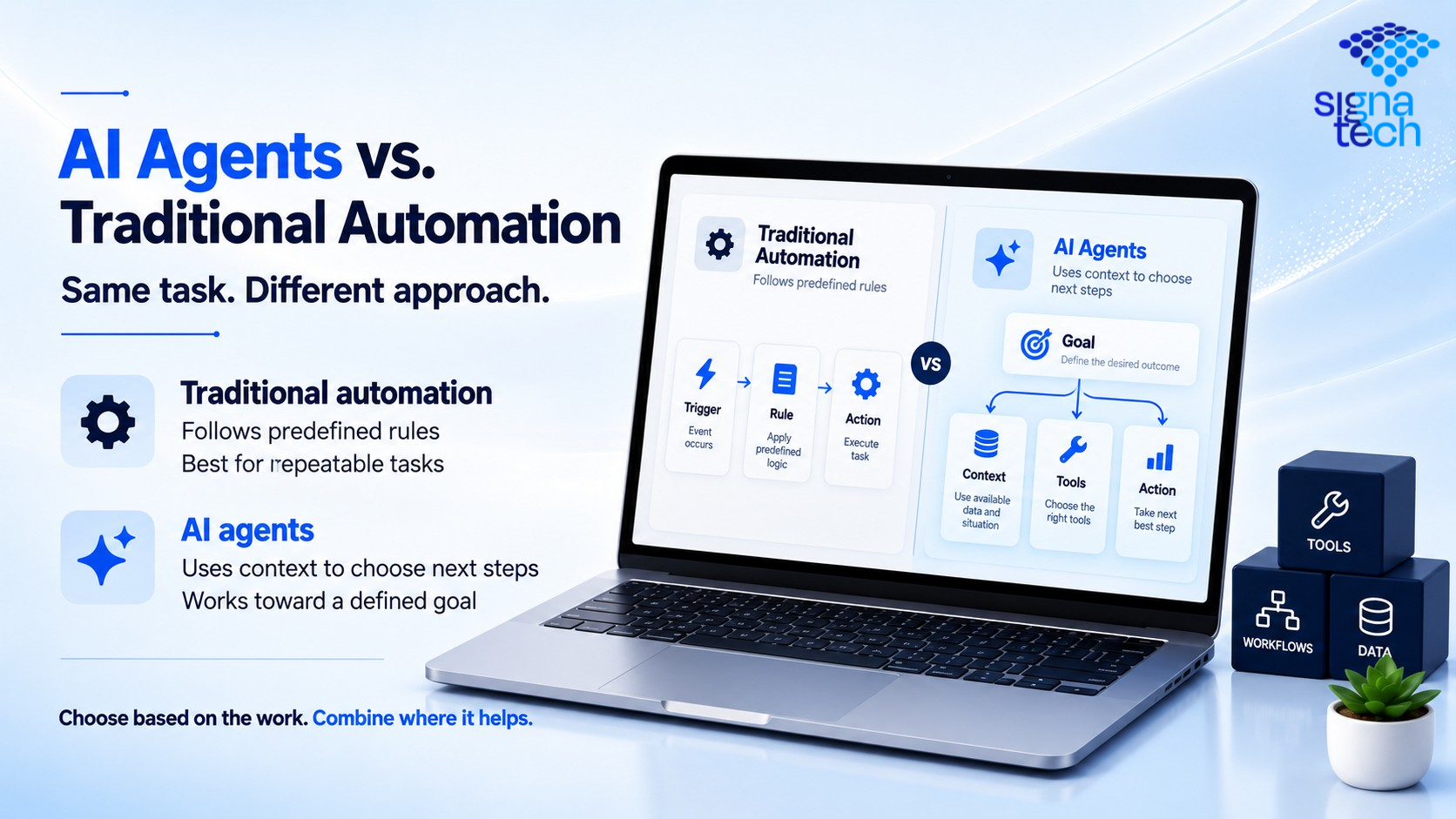
Traditional automation uses predefined rules, triggers, and workflows to execute repetitive tasks. Once configured, the system follows established instructions to complete a process.
For example, a business might use automation to send an invoice after an order is confirmed, update a database when a form is submitted, or notify a manager when inventory falls below a specified level.
Benefits of Traditional Automation
- Consistency: Executes defined tasks according to established rules.
- Predictability: Produces consistent results when the inputs and conditions are understood.
- Efficiency: Reduces manual effort in repetitive processes.
- Cost control: Can reduce the time employees spend on routine administrative work.
- Easy monitoring: Rule-based workflows can be tracked against predefined conditions.
Limitations of Traditional Automation
Traditional automation may struggle when a process involves unexpected inputs, ambiguous information, or decisions that require interpretation. Changes in business requirements may also require workflow modifications.
For well-defined, repetitive tasks, however, traditional automation remains an effective solution.
What Are AI Agents?
AI agents are software systems that can use AI models, available tools, and defined instructions to work toward a particular goal. Depending on their design, they can interpret information, plan steps, retrieve data, and take approved actions.
For example, an AI agent supporting a sales team could summarize a customer enquiry, retrieve relevant product information, draft a personalized response, and recommend the next action for a sales representative.
AI agents can handle more variation than conventional rule-based workflows, but their performance depends on the model, available data, tool integrations, instructions, and safeguards.
Benefits of AI Agents
- Contextual understanding: Can interpret natural-language requests and information from different sources.
- Flexible workflows: Can select from approved actions based on the situation.
- Information processing: Can summarize documents, classify enquiries, and extract relevant details.
- Decision support: Can provide recommendations using available business information.
- Integration opportunities: Can work with business applications and tools when suitable integrations are available.
Limitations of AI Agents
AI agents can produce inaccurate responses or take inappropriate actions if they are poorly configured. They may also require additional integration work, monitoring, security controls, and ongoing evaluation.
Businesses should use human approval for sensitive or high-impact actions and limit agent access to the tools and data required for its assigned responsibilities.
AI Agents vs. Traditional Automation: Key Differences
| Feature | Traditional Automation | AI Agents |
| Operating method | Predefined rules and workflows | AI-driven reasoning and tool use |
| Best suited for | Predictable, repetitive tasks | Tasks involving variable inputs and context |
| Decision process | Fixed conditions | Model-guided decisions within defined limits |
| Flexibility | Depends on configured rules | Can adapt responses to different situations |
| Predictability | Usually high for known inputs | Requires testing and ongoing monitoring |
| Human oversight | Needed for exceptions and changes | Important for uncertain or high-impact actions |
| Example | Automatically sending an order confirmation | Reviewing an enquiry and recommending a response |
The right choice depends on the task. AI agents are not automatically better than traditional automation, and many businesses benefit from combining both.
Real-World Business Use Cases
- Sales and Customer Relationship Management
Traditional automation can assign leads, schedule follow-up reminders, and update CRM fields when specified conditions are met.
An AI agent can help summarize customer conversations, identify the main requirements in an enquiry, draft follow-up messages, and recommend relevant next steps.
Combining the two approaches can help sales teams spend less time on administrative tasks and more time engaging with potential customers.
- Customer Support
Rule-based automation can route support tickets by category, send acknowledgement emails, and escalate requests according to predefined service-level rules.
An AI agent can help interpret customer questions, search approved knowledge sources, summarize previous interactions, and draft responses for review.
A human support representative should remain available for complaints, sensitive information, and complex cases.
- Manufacturing and Operations
Traditional automation can trigger inventory alerts, update production records, and notify supervisors when predefined thresholds are reached.
AI agents can assist with reviewing operational reports, summarizing production issues, and identifying information that may require further investigation.
Actual operational decisions should be based on reliable data, validated recommendations, and appropriate human oversight.
- IT Service Management
Traditional automation can reset approved workflows, create tickets, and send notifications when specific events occur.
AI agents can help classify incidents, summarize error messages, search troubleshooting documentation, and recommend potential solutions.
Access to production systems should be restricted, with approval requirements for changes that could affect business operations.
Can AI Agents and Traditional Automation Work Together?
Yes. A combined approach can be more useful than choosing only one technology.
Consider a customer enquiry workflow:
- A customer submits an enquiry through a website.
- Traditional automation records the enquiry and assigns a lead ID.
- An AI agent summarizes the enquiry and identifies the customer’s stated requirements.
- A rule-based workflow checks the lead assignment criteria.
- The sales representative reviews the summary and approves the next action.
- Traditional automation sends the approved follow-up and records the activity.
In this example, traditional automation handles predictable steps, while the AI agent assists with interpreting variable information.
This approach can improve workflow efficiency while preserving control over important decisions.
How to Choose the Right Automation Approach
Before investing in automation, evaluate the business process carefully.
- Identify the problem. Determine which tasks consume the most time or create recurring errors.
- Assess process complexity. If the task follows stable rules, conventional automation may be sufficient. If it involves interpreting different types of information, an AI-enabled approach may be worth evaluating.
- Review data quality. Both approaches depend on reliable inputs, and AI agents require particular care when interpreting unstructured or incomplete information.
- Check integration requirements. Confirm whether the solution can work with your existing CRM, ERP, databases, helpdesk, or other business applications.
- Define security and approval controls. Establish permissions, audit trails, escalation procedures, and human review requirements before deployment.
- Measure results. Track processing time, error rates, operating costs, completion rates, and customer satisfaction before and after implementation.
- Start with a pilot. Test a clearly defined use case, evaluate its performance, and expand only when the results justify the investment.
What Is the Future of Business Automation?
Business automation is moving beyond simple task execution toward systems that can assist with information processing, workflow coordination, and decision support.
However, successful adoption is not just about implementing the latest technology. Organizations need to choose suitable use cases, integrate systems carefully, protect business data, and measure measurable outcomes.
Traditional automation will continue to play an important role in stable, rule-driven processes. AI agents can complement these systems when tasks require contextual interpretation and more flexible workflows.
For many organizations, the most practical strategy is to combine the reliability of established automation with the capabilities of AI where they provide clear business value.
Conclusion
AI agents and traditional automation serve different purposes. Traditional automation is well suited to predictable, repeatable workflows, while AI agents can assist with tasks involving variable information and context.
Businesses should assess their requirements, data readiness, security needs, and expected return before selecting an approach. A carefully designed combination of both technologies can help organizations streamline operations without sacrificing oversight.
Signatech helps businesses explore technology solutions across AI, software development, business intelligence, and IT services. If your organization is evaluating automation opportunities, connect with the Signatech team to discuss your requirements and identify a suitable starting point.
Suggested CTA: Ready to explore AI-powered business automation? Contact Signatech to discuss your business requirements.
Frequently Asked Questions
Are AI agents better than traditional automation?
Not in every situation. Traditional automation is often preferable for stable, rule-based tasks. AI agents can be useful when workflows require interpretation, flexible responses, or decisions based on varied information.
Can AI agents replace existing automation systems?
AI agents can complement or replace selected parts of some workflows, but a complete replacement is rarely necessary. Businesses should evaluate each process individually before making changes.
Is AI agent implementation expensive?
Costs depend on the complexity of the use case, model usage, data preparation, integration requirements, security controls, and ongoing maintenance. A small pilot can help establish realistic costs and potential benefits.
Are AI agents safe for enterprise use?
They can be deployed with appropriate safeguards, including access controls, monitoring, data protection, testing, and human approval for sensitive actions. Risk management should be part of the design from the beginning.
How should a business get started with AI automation?
Start by identifying a repetitive or time-consuming process, documenting its current performance, assessing data and integration requirements, and testing a limited use case. Measure the results before expanding the solution.