In a fast-paced digital economy, businesses are constantly tasked to go faster, be smarter, and reduce costs. Traditional automation tools such as RPA (Robotic Process Automation) or workflow systems have addressed repetitive tasks. But with processes that are becoming more and more complex the limitations of these older types of solutions have become clear.
Enter AI agents for business automation. These next-gen digital workers integrate artificial intelligence, natural language understanding, and contextual reasoning to not only follow simple “if-then” automation logic, they can learn, adapt, and make decisions in real-time.
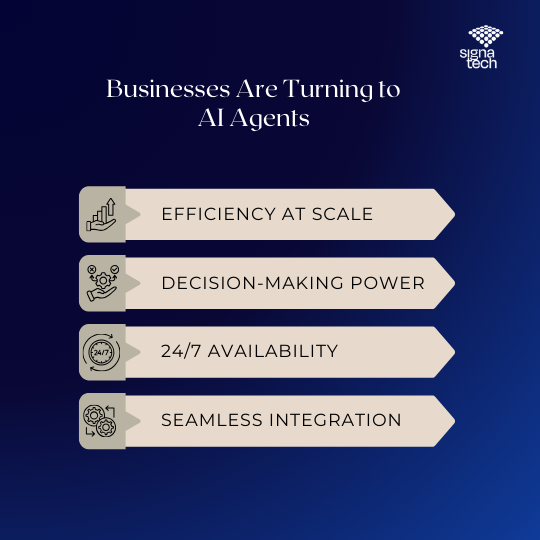
Why Businesses Are Turning to AI Agents
The emergence of AI agents for business automation is not by accident. There is an awakening for business that automation alone is insufficient. Businesses need intelligence embedded into their workflows to grow sustainably.
Here are the reasons organizations are moving to this model:
- Efficiency at Scale
- AI agents can run repetitive operations like invoice handling, scheduling, and data entry.
- They can scale immediately without adding new headcount.
- Decision-Making Power
- AI agents have access to massive datasets and can analyze trends, detect anomalies and recommend informed actions.
- For example, a sales AI agent can forecast demand shift better than manual methods.
- 24/7 Availability
- AI agents work anytime, providing real-time support for customers, suppliers, and employees.
- They virtually eliminate time zone and staffing delays.
- Seamless Integration
- Modern AI agents are built the integrate into ERP, CRM, HR, and marketing systems.
- Approved systems mean that businesses don’t need to throw out existing infrastructure to start using them.
Real-World Applications of AI Agents
To comprehend value, let’s examine how AI agents for business automation are transforming sectors:
- Customer Service
- AI conversation (chat-based & voice) agents answer questions, complaints, and process sales transactions in real-time.
- AI agents lessen wait time and free human agents to spend time in high-value interactions.
- AI conversation (chat-based & voice) agents answer questions, complaints, and process sales transactions in real-time.
- Finance & Accounting
- AI agents perform reconciliations, flag suspicious expense transactions, and flag purchases for approval.
- With each flagged fraud decision, fraud detection improves through AI system learnings.
- AI agents perform reconciliations, flag suspicious expense transactions, and flag purchases for approval.
- Healthcare
- Hospitals are utilizing AI agents to track patient records, automate scheduling of patient appointments, and process insurance claims.
- AI agents free doctor’s schedules for more direct patient care.
- Hospitals are utilizing AI agents to track patient records, automate scheduling of patient appointments, and process insurance claims.
- Human Resources
- AI agents will screen resumes, assist in scheduling candidate interviews, and monitor employee level of engagement.
- Some AI agents offer measurable insights and analyses of worker productivity.
- AI agents will screen resumes, assist in scheduling candidate interviews, and monitor employee level of engagement.
- Supply Chain & Logistics
- AI agents will track shipments, manage demand surges, and control delivery schedules.
- AI agents minimize delays and lower your costs.
- AI agents will track shipments, manage demand surges, and control delivery schedules.
The Advantages Over Traditional Automation
Traditional automation is rule-based: if X happens, then do Y. Business environments are also dynamic ones, and rules can break down when the conditions change. AI agents on the flip side:
AI agents, on the other hand:
- Learn Continuously – AI agents do not require reprogramming each time the conditions change.
- Handle Unstructured Data – AI agents are capable of processing everything from email, chat transcripts, images, and audio.
- Think Holistically – An AI agent is not just processing steps. They are thinking about goals and outcomes.
This flexibility affords them a full range of future readiness, unlike static automation systems.
Challenges in Adopting AI Agents
While the benefits are significant, organizations must also address challenges:
- Data Privacy & Compliance – Making sure in terms of meeting requirements and protect sensitive data.
- Integration Complexity –Effectively getting AI agents integrated into core legacy systems.
- Change Management – Enabling teams to trust AI agents and begin collaborating with them.
- Initial Investment – Costs may seem high, but ROI often offsets them quickly.
Organizations that have had the best success have had adoption with a clear strategy, solid data governance, and iteratively piloted implementations.
The Future Outlook
Analysts estimate that AI agents will be as prevalent in enterprises as email systems within the next 5-7 years. But instead of employees manually switching between apps, the AI agents will manage workflows, trigger actions across many platforms, and make proactive recommendations.
Picture a near future where:
- A marketing AI agent launches campaigns, tests variations, and automatically reallocates budgets.
- A procurement AI agent negotiates supplier contracts in real-time.
- A project management AI agent allocates resources and resolves bottlenecks before people even see them.
This scenario is not a decade from now, it is happening.
Moving from automation into intelligent, adaptive AI agents for business automation is one of the most important technological steps of our time. Companies that choose to move forward with these solutions will function with increased efficiency, increased intelligence, and increased agility if they are continuing to rely on pre-automation business practices!
At SignaTech, we’re on the cutting-edge of implementing AI-enabled solutions that empower organizations to operate with a new level of productivity and intelligence. Our AI-Agent-Solution can be integrated in your business processes to provide better decision making, faster execution, and the opportunity for scalability.
The future of intelligent automation isn’t coming, it has arrived. Contact SignaTech today to learn about how to leverage our AI-Agent-Solution to transform your workflows; save money; and future-proof your business.