The healthcare sector has historically relied on experience, intuition, and manual recordkeeping for decisions. However, as digital health records, patient monitoring devices, and administrative software have proliferated, providers have been inundated with data. The issue lies not in access to data but in the ability to use it in a meaningfully productive way. This is where business intelligence (BI) in healthcare becomes critical.
Business intelligence (BI) facilitators for hospitals, clinics, and healthcare systems to collect, organize, and analyze large amounts of data to improve clinical outcomes and make healthcare delivery more efficient. Poor data leads to poor clinical decision-making. Good decision-making requires good technology. With the right BI tools, decision-making can be more accurate, faster, and based on real-time and real-world data. Business intelligence in healthcare can facilitate providers to make improvements like reducing hospital readmission rates or predicting potential disease outbreaks.
Why Healthcare Needs BI More Than Ever
Healthcare is the most data-driven industry in existence. Each patient produces hundreds of data points including but not limited to: diagnosis, lab results, billing information, medication history… and it goes on. However, most of this information is left untapped and goes un-analyzed.
Business intelligence in healthcare provides meaning to these numbers. It assigns visual dashboards, actionable insights and predictive analytics that lead to better decision making. Do you want to improve and enhance patient safety? Increase resource utilization? Expand operational transparency? BI is the backbone of your organization and enables you to think strategically about those questions.
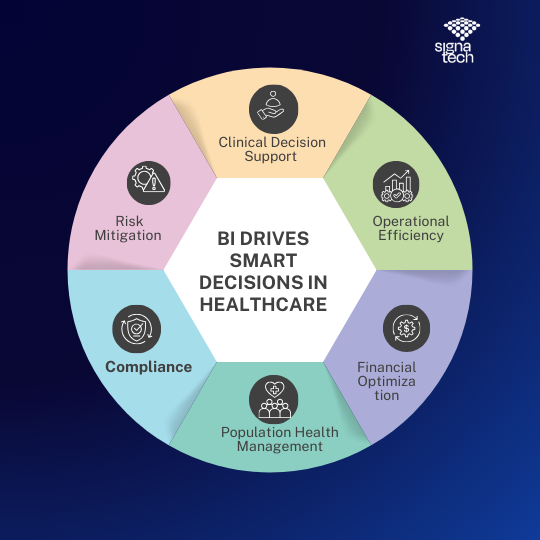
How BI Drives Smart Decisions in Healthcare
BI solutions support both clinical and administrative teams. Here’s how they make a measurable difference:
Clinical Decision Support
Physicians and nurses use BI tools to monitor patient vital signs, review historical trends, and forecast possible complications in response to acute changes in a patient’s condition. This can lead to quicker intervention by care teams, greatly improving patients’ outcomes.
Operational Efficiency
Hospital administrators can track numerous metrics, including room occupancy, patient appointment no-shows, average length of stay, and staff utilization. BI tools reveal bottlenecks and highlight ways to minimize waste.
Financial Optimization
The finance team looks for revenue leaks, insurance claim authorizations, and over billing or under coding potential. With their understanding of the money flow cycle and BI’s insight into financial trends, the institution can forecast cash flow and help eliminate waste.
Population Health Management
BI systems can look at whole populations and analyze and recognize trends among them. BI can identify certain communities with significantly high chronic diseases or certain patients with decreased compliance for screening on preventive health interventions and services. This helps healthcare providers roll out enhanced outreach and preventative educational campaigns.
Compliance and Risk Mitigation
Healthcare leaders generally have to deal with a litany of policies and quality regulatory standards. BI tools allow the organization to strengthen data accuracy, monitor care protocols, and reduce opportunities for human error, which can lead to avoidance of fines or lawsuits.
#image_title
Real-World Benefits of Business Intelligence in Healthcare
Healthcare organizations using BI effectively report tangible improvements:
- Reduced hospital readmissions through predictive analysis of at-risk patients.
- Faster emergency room processing by monitoring peak hours and staffing accordingly.
- Improved patient outcomes by identifying early warning signs in clinical data.
- Higher patient satisfaction through reduced wait times and streamlined services.
- Cost savings by identifying inefficiencies and minimizing waste.
Challenges in BI Adoption and How to Overcome Them
While the advantages are significant, adopting business intelligence in healthcare comes with its challenges:
- Data silos: Information is often scattered across systems that don’t communicate well.
- User resistance: Medical staff may be hesitant to adopt new technologies.
- High initial investment: BI platforms can be expensive to implement and integrate.
- Training gaps: Staff may lack the skills to interpret data insights.
To overcome these, organizations should start with a phased implementation, prioritize training, and ensure leadership buy-in. Choosing the right BI platform one that integrates easily with existing Electronic Health Records (EHR) and offers intuitive dashboards is critical to success.
The Future of Healthcare is Data-Led
BI is not just a tool; it’s a mindset shift toward evidence-based operations. As artificial intelligence (AI), machine learning, and IoT become more intertwined in health systems, BI will be capable of even more. Predictive alerts for issues, patient behavior modeling, optimizing clinical trial results, and so on, are possible when BI continues to mature in the health care process.
Moreover, and quite thankfully, as remote care, telemedicine, and virtual health become staples, the principles central to BI are foundational as health care organizations begin to monitor decentralized patient data. This will ensure that quality of care is maximized, no matter where it is provided or how it is delivered.
BI Isn’t Just Useful-It’s Indispensable
Business intelligence in healthcare allows its providers to act with clarity, speed and confidence. This has allowed healthcare providers to accomplish things previously thought to be impossible ranging from diagnosing diseases quicker or running a more effective hospital. It unites departments, identifies blind spots, and keeps organizations agile in an ever-changing landscape.
As data becomes more complex and expectations continue to evolve in years to come, those who are using business intelligence in healthcare will not just succeed as organizations but as advocates for healthier communities. The future of healthcare is not about care, it’s about smart, data-informed care.
To make that future a reality, working with the right partner matters. At SignaTech, we offer specialized business intelligence consulting services tailored for the healthcare sector. From system integration and data visualization to predictive analytics and real-time reporting, we help providers unlock the full potential of their data. If you’re ready to turn your healthcare data into decisions that save lives and improve operations, SignaTech is here to guide your transformation journey.