
In a rapidly changing digital landscape, success is no longer defined solely by an organization’s products or services; it depends on how effectively every part of its ecosystem is connected. From internal operations to customer experiences, modern businesses thrive on integration, agility, and actionable insights. This is where Digital 360 comes into play not just as a framework, but as a philosophy that empowers businesses to evolve into fully connected digital enterprises through digital transformation solutions.
The Age of Connected Business
“Connected business” is more than just about having the right IT infrastructure; it is about forming an intelligent network of people, processes, and technology that can easily communicate. Whether it is sales, marketing, supply chain or customer support, each department’s role is to create one seamless flow of data and decision-making.
Typical business silos delay a business’ ability to operate effectively and creatively waste a business’ resources while often providing customers with an overall inconsistent experience. Digital 360 transforms siloed business departments and functions by connecting platforms, automating repetitive administrative tasks and ensuring that real time data insights inform every action.
With the digital transformation solutions, organizations can now have the ability to leverage an integrated and seamless 360-degree view of operations, customers and metrics for performance. Not only does this enable the company to run smoothly and inform data-based decision-making, it also enables leaders to work and make decisions more optimally and efficiently.
Core Pillars of Digital 360 Transformation
A connected business rests on 4 core isolated aspects, each supported by tailored digital transformation solutions:
- Integration
Integration ensures that the overall data flow seamlessly between all systems i.e. CRM, ERP, Analytics and IoThrough the use of API architecture, companies can create a connected pipeline of data that connects all the systems of record in a business.
For example, if a retail chains’ inventory, billing, and CRM systems are connected then the organization can learn all the information about stock movement, customer buying behavior, and supplier performance from the same dashboard.
- Automation
Automating absolute to reduce human error and increase productivity. From robotic process automation (RPA) in back office functions to automated workflows in sales and marketing, automation is at the heart of a connected enterprise, allowing human employees to focus on the strategic work, while tasks such as order confirmations, data entry, and report creation can work on their own behind the scenes.
- Intelligence
Data, without context, is simply noise. And digital transformation for existing enterprises is enabled by AI-led analytical and business intelligence (BI) solutions to develop raw data into insights that can result in action. Insights enable organizations to determine trends, forecast demand, and personalize customer experiences.
Examples of BI solutions in retail generate interactive dashboards that are visually describe the insights coming from sales performance, inventory health, and customer interaction.
- Experience
A true digital 360 approach will always depend on user experience; that is, what an employee sees when they click on their items in an internal dashboard or the customer experience when viewing items for purchase in an online store. If customers and employees can take advantage of all touchpoints from connected platforms they will be able to create consistent, engaging, and personalized experiences that will drive even greater loyalty.
Why Businesses Need Digital 360 Now
1.Customer Expectations Have Changed
Customers expect seamless interactions no matter if shopping online, contacting support, or walking into a physical store. Companies that do not align their digital touchpoints risk losing customer engagement and trust. Digital transformation solutions allow you to observe customer behavior, try to understand what they are looking for, and whether you are recommending personalized options in real-time.
- Data is the New Fuel
Every business generates tons of data everyday – from sales logs to social interactions. But without proper connectivity, most of this data is lost. A Digital 360 framework brings this way of thinking together and visualizes the data in one place to support organizations in strategically making decisions based on data you can accurately and in live-time.
- Agility is the Key to Survive
Market conditions change more quickly than ever before. Organizations that adapt instantaneously – whether it’s a new digital service, scaling operations, or changing business models in the moment – are the ones that will survive. Cloud-based systems and AI expansion and cloud-based systems and AI-driven platforms allow your organization agility and the ability to thrive with uncertainty.
How to Implement Digital 360 in Your Function
Transitioning to a connected physical space does not happen overnight, it requires a roadmap and digital transformation solutions.
- Assessment: Find those connections in your organization or areas where manual process are still utilized.
- Technology selection: Assess and select platforms that can easily integrate with your current applications (ERP, CRM analytics, etc.).lower
- Automate: Start automating repetitive workflows within HR, finance, or operations.
- Unify Data: Use BI tools like Retail BI to harness all data across the company and analyze and visualize in one place.
- Optimize: Use analytics to analyze project success and improve year after year or change your processes accordingly.
The Engines running AI and Business Intelligence
AI and Business Intelligence is the engine of the Digital 360 model. Together we demonstrate predicting customer behavior, inefficiencies, and those unique growth opportunities.
Think about retail, BI dashboards can show which products are performing well within regions, forecasts on seasonal demand, and then how to optimize inventory distribution, or to simply have an overall smell of different stock. This knowing level of intelligence for leaders places you to act recognized and risk averse as opposed to reactive, a value able but unique position in competitive markets.
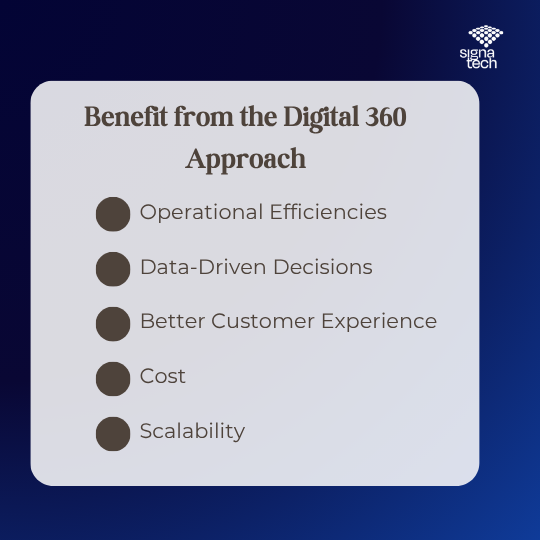
How we benefit from the Digital 360 Approach
- Operational Efficiencies: Automating workflows decrease down time and reliance on human.
- Data-Driven Decisions: Having a single source of truth relieves the own risk of inaccurate data.
- Better Customer Experience: Improved personalized engagement within every engagement channel.
- Cost: Overhead and wasted resources are decreased.
- Scalability: Cloud based digital transformation solutions allow for grow without all the heavy cost of infrastructure.
In an era where connectivity is built on, Digital 360 is not simply a digital upgrade to any function, it is a complete remapping of business working. With digital transformation solutions in place, organizations will close the operational gaps in their function, accelerate growth, and innovate around the capabilities mapping their functions beyond market change through the laid foundation of an ecosystem.
At SignaTech, we help business reach this connected vision, through our innovative Retail BI service to drive and generate real-time insight, automating the analytics part of your decision making, .
If your hope is to translate data into intelligence and operations into flourishing beings, start your Digital 360 journey with SignaTech.