
In the past decade, Business Intelligence (BI) has witnessed a seismic shift. Companies have evolved from using traditional spreadsheets to interactive dashboards with the ability to explore, visualize and slice data in real time. While this was great, dashboards can also feel very constraining as data is continuing to evolve and become increasingly complicated. Even dashboards can feel cumbersome because they are still limited in utility – you still need technical capabilities, still need to set it up just right, and sometimes require a couple of clicks to get to the right response.
Conversational BI with AI Agents is revolutionizing all of that – taking the user from clicking through charts, to simply asking questions and receiving contextual and human-like answers in real-time.
The Evolution of Business Intelligence
- Static Reporting (Pre-2000s):Reports were printed or emailed periodically, and by the time decision-makers got them, often they were outdated.
- Interactive Dashboards (2000s-2010s):Following the advent of interactive dashboards and visualization tools like Power BI, Tableau, and Qlik, users were able to more deeply look at their data and explore the various patterns.
- Augmented Analytics (2020s): Following the advent of interactive dashboards and visualization tools like Power BI, Tableau, and Qlik, users were able to more deeply look at their data and explore the various patterns.
- Conversational BI (Now): Rather than dashboards, decision makers simply talk, via chat, with an AI agent to understand context, query and intent.
What is Conversational BI with AI Agents?
Conversational BI is a means of interacting with yourInstead of asking an analytics analyst to write a report, a manager may type or read aloud:
- What were our top three performing regions last quarter?
- Show me a trend line for new customer acquisition over the past six months.
- How did our ad spend efficiency compare on Google Ads and Meta Ads in August?
The AI agent then gathers data, processes it, and reports it (often with rationales and suggestions for follow-up actions), making Business Intelligence easier than ever.
Why Traditional Dashboards Are Not Enough
Dashboards are strong but limited:
- Steep Learning Curve: There is much to learn to know how to understand filters, fields, and hierarchies.
- State: A dashboard gives us a set of answers to defined questions but we are limited if we have spontaneous inquiries.
- Information Overload: Bombarded with too many charts, users feel impotent rather than empowered.
- Dependent on Analyst: Non-technical staff don’t know how to drill down and get to specifics.
AI agents, conversely, can break barriers by allowing naturally occurring, conversational access to insights.
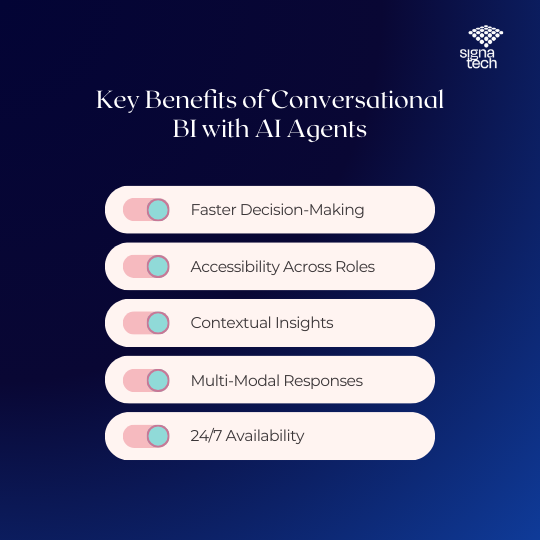
Key Benefits of Conversational BI with AI Agents
- Reduced Decision Time- Manages can query the data using the AI agent in real time, rather than waiting for new reports.
- Access for All Roles- From frontline workers to executives, all users can get answers without any specific technical training.
- Contextual Access- AI agents do not just return numbers but provide an explanation, correlations to other data, and suggested follow-up actions.
- Multimodal Access- Data can be returned in the form of text, charts, voice, or embedded into apps on sites like Slack or Teams.
Practical Applications in Enterprises
- Sales Teams
- Ask: “What is the revenue gap between my forecast and actual for Q3?”
- Output: An analysis constructed in charts, including suggestions on which regions to focus on since they performed poorly.
- Marketing Departments
- Ask: “Which of my campaigns produced the greatest ROI last month?”
- Output: A breakdown of campaigns tracking cost vs. conversion, followed by a suggested strategy for campaigns moving forward.
- Supply Chain & Logistics
- Ask: “Where our current delivery times are bottlenecked in the supply chain?”
- Output: Supply chain analytics in real-time, along with predictive alerts to manage the flow of data.
- Healthcare & Operations
- Ask: “What are the admission trends for patients in this season compared to last year’s admission trends?”
- Output: AI developed insights that included predictive demand modeling.
How AI Agents Enhance Conversational BI
The sophistication of conversational agents is not isolated to access alone—the agentic intelligence in these systems also extends to:
- Memory & Context
Agents can remember which questions have been asked in the same session which affords a follow-up question such as: “If I could see only for New York region.”
- Proactive Alerts
If query triggers are in play, a manager does not have to wait for someone to answer a question like; “Your churn rate is high (12%) this week, do you want to see the reasons why?”
- Integration and Connectivity with Business Apps
They draw all standards to connect with different pipelines associated with CRM, ERP, and Analytics.
- Governance & Security of Data
Agents operate in a compliant manner according to enterprise governance for accessing information, preventing sensitive data from being pushed where it should not be.
Challenges and Considerations
Conversational BI is a great forward-thinking application, but can be troublesome as well:
- Data Integrity: Garbage in, garbage out. Agents rely on data for clean/sound data.
- Trust: Users need enough faith in the AI to believe they’re not “hallucinating” insights.
- Adoption Curve: Organizations may not allow for possible adoption curves, as they may not convince stakeholders to realign from dashboards.
- Cost of Implementation: Commitment of funding, not all organizations, will have this funding for AI research/education/upgrades.
The Future of BI: Dialogue Over Dashboards
We are facing a future where dialogue replaces dashboards; instead of hours spent designing dashboards and charts to relay to your team, organizations will be able to work with AI Agents that can:
- Auto-generate narrative text about a measurement of performance.
- Provide patterns with predictive suggestions based on the past.
- Provide perspectives where every team member has access to BI and acts as their own personal BI co-pilot for their work.
Bullet Point Summary
- Dashboards are powerful but constricted; Conversational BI allows for natural and on-demand insight.
- AI Agents will adopt the ‘BI’ position and lift the following: memory, context, and proactive alerts.
- Versatile applications should exist in Sales, Marketing, Logistics, and Healthcare.
- Advantages: speed, paying for an assistant that does not have to sleep, ease of readability, contextual intelligence, 24/7 operational ability.
- Success: requires believable, sound data, trust access, and cultural adoption.
As organizations mature into data-driven operations, actionable, actionable, immediate, measured, context-relevant insights are not optional anymore; they are mission-critical. Conversational BI with AI Agents is the next frontier in Business Intelligence, intertwining analytics and dialogue and providing ability for decision-makers to pay attention to temporary dashboards and working on making decisions based on insight provided.
At SignaTech, we see the journey forward from preparing BI applications to preparing Agent Powered Platforms that enhance business dialogue to enable measurable outcomes. Our promise is that having the Agent Powered relationship will be a change for organizations, as it is more than a step forward in moving from dashboards to dialogue, it is revolutionary.