
The introduction of embedded technologies in industries is changing the way industrialised products are designed and manufactured and how individuals interact with their machines. Embedded systems will experience a significant shift from primarily using basic sensors and processors to being intelligent and self-operating (meaning they can operate without human intervention), communicating, and connecting with each other within five years. This significant change will be driven by changes in the following areas: microcontrollers, artificial intelligence (AI), Edge computing (which allows computers close to where they are perceived to be working), communication networks, and the emergence of cloud-native architectures (where applications deploy multiple servers on the Internet).
This paper discusses the evolution of the embedded system over the next five years and highlights some technologies that will dominate over this time frame and therefore what will have an impact on the various industries, including healthcare, manufacturing, automotive, retail, smart city development, etc.
- Beyond Basic Sensing to Intelligent Data Processing
In the past, embedding systems had a simple flow of information where the process for data was: sense, process, and then send to output.
Because of the significant improvement in the speed, capacity, and performance of MCUs as well as low-power chipsets, the accelerometers are evolving into mini-computers capable of being highly intelligent.
Some of the major transitions occurring in today’s embedded systems:
- High precision sensing technologies: Sensor technology in embedded systems continues to develop into high speed, high durability, and low-energy use.
- Edge-level computing: In the past, almost all data collected from embedded sensors was sent to the cloud where the data was processed. Currently, most modern embedded systems now process their data locally, thereby making embedded systems considerably faster and more reliable than their older equivalent technologies.
- AI based microcontrollers: As embedded systems continue to evolve, manufacturers of microcontrollers/SoCs are designing their products to be capable of integrating machine-learning capabilities, known as TinyML, which enable them to conduct on-device analytical and predictive capabilities.
Within five years, embedded systems will experience a transitional period where they will become fully autonomous, meaning they will no longer require constant monitoring from a human being.
- The Emergence of AI Powered Embedded Systems
Artificial intelligence has driven a major amount of innovation in the embedded systems. As machine learning continuously improves and becomes smaller, the advanced capabilities embedded systems will have will become more advanced and perform tasks that were previously un think. The introduction of Artificial Intelligence (AI) in embedded devices represents a major change in technology. In the past, embedded devices were limited to either being data collectors or being able to perform certain tasks based on logic. The addition of AI allows embedded solutions to become more intelligent and therefore able to learn and improve their performance over time using Machine Learning (ML).
Machine Learning (ML) is used in such a way that embedded solutions will now have the ability to analyse their environment and provide accurate predictions, enabling organisations to utilise the devices in a more productive and intelligent manner. The ongoing usage of AI is allowing for the ongoing development of numerous products, services and solutions within embedded environments, and therefore AI is one of the main drivers of this growth.
Another major aspect of AI is that the use of AI will enable manufacturers of electronic devices to manufacture products with much higher quality than previously. By eliminating issues related to manufacturing defects and increasing efficiency during production, many manufacturers will be able to produce a variety of products, all with greater quality.Ultra Reliable, Ultra Fast Connectivity In the Next 5 Years
In the next five years, embedded systems will heavily depend on the following emerging communications connectivity solutions for advanced connectivity:
- 5G and future 6G
- Wi-Fi 7
- LoRaWAN (Low Power Wide Area Networks – LPWAN) and Ultra Low Power Wide Area Networks
- Matter protocol for Smart homes
- Vehicle to Everything (V2X) communications
These emerging communication technologies will enable the following:
- Zero latency data transfer
- Wide mesh networks of interconnected devices
- Real-time monitoring and automation
- Massive IoT deployment across factories and cities
- Embedded Technology’s Future is Dependent on Adopting New Communication Technologies to Provide a Seamless Device-Cloud-User Ecosystem
- Embedded Systems Must Be Secure by Design
- As embedded systems become smarter and more connected, they will become more vulnerable.
- Within the next five years, security will be built into embedded systems at the hardware level, instead of being an option.
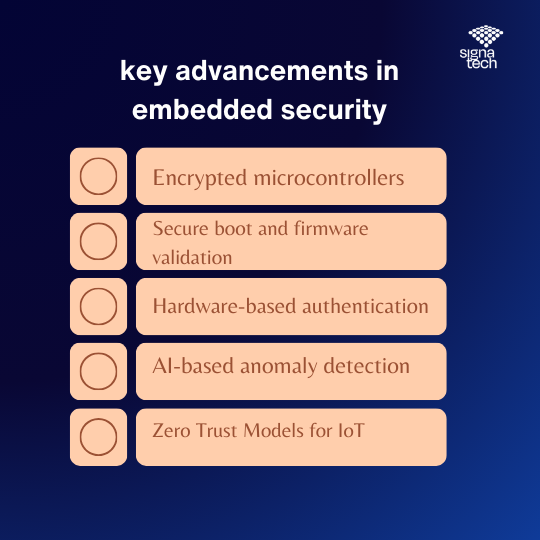
The following key advancements in embedded security will occur:
- Encrypted microcontrollers
- Secure boot and firmware validation
- Hardware-based authentication
- AI-based anomaly detection
- Zero Trust Models for IoT
To provide a secure design, every embedded product will have to be secure by design, particularly in sectors like healthcare, automotive, BFSI, smart home and defense.
Embedded Systems Will Enable Smarter Industries
Smart Manufacturing: The fourth industrial revolution (Industry 4.0) will continue to grow with:
- Real-time machine health monitoring
- AI-enabled robotics
- Automated quality control
- Digital Twin Technology
Healthcare: Embedded Medical Devices will enable:
- Real-time patient monitoring
- Portable diagnostic devices
- Wearable health care tracker based on artificial intelligence (AI)
- Automotive: The future automotive vehicles will include:
- Advanced Driver Assistance Systems (ADAS)
- Autonomous vehicle features
- Smart Cockpit System
- Predictive Vehicle Diagnostics
Smart Home & Smart Cities: In the next five years, we will see widespread adoption of:
- Energy-efficient embedded appliances
- Smart metering systems
- Traffic monitoring/pollution monitoring sensors
- Smart public infrastructure
This is only the beginning. In the next five years, embedded systems will be the backbone of each modern industry.
The Next Stage of Embedded Systems: Autonomous Embedded Systems
The future of embedded systems is not just connected to other systems, but rather, self-managing and operating completely autonomously.
The upcoming technology of autonomous embedded systems will feature the following:
- Self-calibrating systems
- Self-healing systems based on an AI-based prediction of failure
- Collaborative fleets of embedded devices that work together
- Real-time decision-making systems that do not require dependency on either the cloud or central control
This represents the natural progression of embedded technology to a new level in which embedded devices and systems will think, act, and respond as an intelligent digital assistant.
Over the next five years, the evolution of embedded systems will bring revolutionary transformations to each industry, including smarter sensors, AI-driven microcontrollers, secure and connected edge devices, and the overall transformational effect of embedded systems in how organizations and people operate.
As organizations transition into the next phase of technology, they will need to partner with strong organizations that can help develop and implement embedded systems that incorporate advanced technologies, including embedded architecture, AI, cloud computing, and real-time processing.
As a leading technology provider, Signatech and Digital 360 serve as partners in helping organizations to migrate to next-generation embedded systems that provide the right combination of rapid and secure connectivity, storage, and cloud integration.