
Manufacturers are under increasing pressure to cut margins, manage fluctuating demand, and deliver faster with fewer errors. In the manufacturing world, Business Intelligence (BI) is no longer an option it’s a necessity. BI transforms the raw data hidden across ERPs, production lines, warehouses, and sales systems into actionable insights that help manufacturers reduce waste, prevent stock issues, and operate more efficiently.
- From “Gut Feeling” to Inventory Decisions Backed by Data
- Many inventory decisions makers have relied on instinct and educated guesses for years:
- “I know that item moves, keep more.”
- “I don’t think that material is used that often, keep a little.”
What’s the issue? Demand changes, seasons change, and one poor estimate can tie up thousands or millions of rupees of dead stock.
Business intelligence, in the manufacturing context, takes procurement decisions from guess to fact:
- Historical sales and consumption history are examined.
- Patterns by season, location, customer type, product line, etc., emerge.
- BI flags a management alert when items are overstocked, understocked, or on the stock at risk list.
This lets planners evaluate reorder points, safety stock and minimum order quantities using the data, eschewing DNA.
- Real-Time Visibility Across the Value Chain
- The issue for many manufacturers is that their data is spread out:
- Production data somewhere,
- Purchase orders somewhere else,
- Warehouse inventory in Excel, and,
- Sales data in a separate CRM system.
BI bridges the gap to a real-time view of:
- “How much of each raw material do we have right now?”
- “Is there any finished goods in stock at this warehouse compared to other warehouses?”
- “Are our suppliers being timely, or generating last-minute changes to our production schedule?”Having a single source of truth enables teams to act more quickly—whether it’s reallocating stock between locations, modifying purchase orders, or reorganizing production prior to a stock-out or over-stock event.
Minimizing Waste through Improved Demand Planning
One of the largest sources of waste generated comes from not matching production with demand. When you make too much of something, it expires, becomes obsolete, or requires deep clearance discounts to sell it. When you produce too little, you lose sales and incur expedited batches that are inefficient.
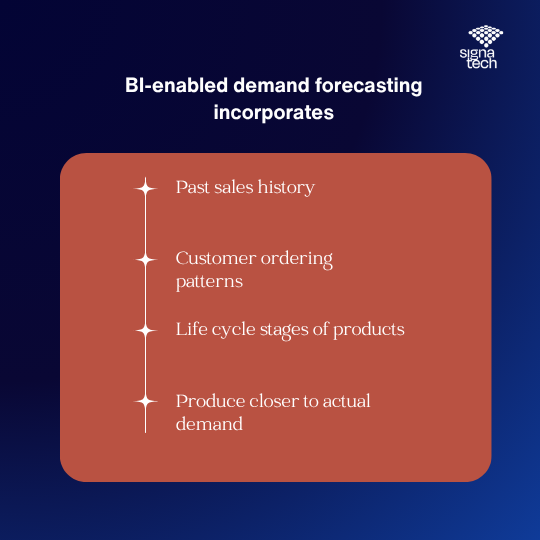
BI-enabled demand forecasting incorporates:
- Past sales history
- Customer ordering patterns
- Seasonality (holidays, exporting cycles, peak times unique to the industry)
- Life cycle stages of products
- Produce closer to actual demand
- Remove inventories of large slow-moving stock
- Plan raw materials purchasing more accurately
- Over time, forecasting accuracy increases, and waste from excess inventories decreases.
- Identifying Slow-Moving and Non-Moving Inventory
A powerful and simple application of business intelligence in manufacturing is identifying “problem” inventory.
- Slow-moving: an item that sells, but very slowly
- Non-moving: an item that has not sold for an extended time, like two months
- Business intelligence dashboards can show you:
- Value stuck in each box
- Ageing reports (30 / 60 / 90 / 180+ days)
- Items close to expiration or obsolescence
- Now that you can see this level of detail, you can:
- Run clearance or bundle offers
- Re-engineer products to consume dead material
- Stop buying the offending SKU
This will directly reduce your carrying cost, and free up your working capital and warehouse space.Reducing Production Loss and Scrap
Inventory waste doesn’t just sit on shelves. It also exists on the shop floor:
- Excess raw material usage.
- Frequent changeovers on machines.
- Rework caused by quality concerns.
- Scrapping due to out-of-specifications or poor planning.
- BI can blend data from production, quality and maintenance systems to show what:
- Machines or lines generate the most scrap.
- Shifts or operators have higher rejections.
- Materials or suppliers cause more quality complaints.
With this data, and presented as daily/weekly dashboards, plant managers can target improvement where it will have the most impact, reducing materials waste and hidden costs.
Optimizing Safety Stock Without Stock-Out Risk
Safety Stock is needed, but can be dangerous if you don’t manage it properly. Too low, production stops. Too high, money is unproductive sitting in inventory.
With BI, manufacturers can:
- Understand variability in supplier lead times.
- Understand volatility in customer demand.
- Simulate various safety stock scenarios.
This leads to a scientific safety stock strategy – enough to protect from shocks, but not so much that it sits silent as waste,
Mobile Friendly BI: Working Where You Work
- Today’s operations leaders aren’t always in a desk. mobile friendly BI dashboards mean:
- Plant heads see critical stock alerts sitting chez eux.
- Heads of purchasing go on notice for someone to catch low stock or urgent POs.
- Heads of sales can see ready-stock prior to confirming orders.
- Mobile BI combined with BI based on manufacturing lead to quicker, better decisions and snuff out issues that would grow into crises.
Culture Shift: From Blame to Continuous Improvement
When BI is done well, it leads to cultural changes – beyond inventory numbers improving: Discussions go from “I think” to “data shows…”
- One version of the truth (rather than multiple manually entered files).
- Projects to improve based on impact – not who is politically supporting it.
- Over time, this builds a habit for everyone – from the order picker to CEO – data first, decision second.
BI as the Engine of Lean, Smart Manufacturing
Inventory and waste are silent killers of profit in manufacturing.BI provides manufacturers visibility, analytics for better forecasting, better stock policies, and wherever possible continuous visibility of where money is being blocked or burnt.
When BI connects to ERP, production, sales and warehouse systems, BI becomes a BI service that not only analyzes the past, but determines what should be done and assures business continues into the future. For manufacturers embarking on, or strengthening BI capabilities, working with specialists who understand both the technology and factory reality is fundamental.
This is exactly where SignaTech’s Business intelligence service can enable manufacturing businesses to turn data into decisions, and decisions into measurable productivity/stores and greater sustainability.