

Manufacturing has become an increasingly competitive industry requiring real-time insight—not as a luxury, but as a necessity. Unfortunately, many companies invest in complex Business Intelligence (BI) tools, only to find their teams are not using them. User adoption of BI tools cannot happen simply because a company has dashboards available. In order to drive user adoption of BI tools, organizations need to develop a culture of embedding BI usage into the daily workflow of employees. This will require a migration away from bringing BI into the workflow on a “just-in-time” basis, while also helping employees feel confident in their ability to leverage data to make decisions on a regular basis.
Why User Adoption Matters in Manufacturing
The job of the manufacturing employee is complex: managing the supply chain, production planning, quality control, and scheduling maintenance. If BI doesn’t have a strong rate of user adoption, the BI tools will go underutilized and will not deliver value.
When adoption is high:
- Production teams can quickly identify where bottlenecks are occurring.
- Quality managers can track down the source of defects or problems to prevent issues from occurring in the future.
- Supply Chain leaders can compare the cost of procurement against their forecast models to maximize resource utilization and minimize costs
- Executives can make strategic decisions based on ground-level data.
Simply put, the amount of ROI from BI tools is going to be determined by whether or not the employees utilize the tools.
Key Challenges in Adoption
Before focusing on improving user adoption, it is important to recognize what the barriers may be:
- Resistance to Change – Many employees have become accustomed to manual reporting or spreadsheets, and simply switching to business intelligence tools or dashboards feels daunting.
- Complex Dashboards – If the dashboards are too complicated, people will not use them.
- Insufficient Training – If employees do not understand how to use the tools they simply will not use them. Unclear Value – Unless you can show how BI supports employees in their day-to-day jobs, employees will view BI as “extra work.”
- Data Silos – The lack of connected data sources results in lowering trust in the reports.
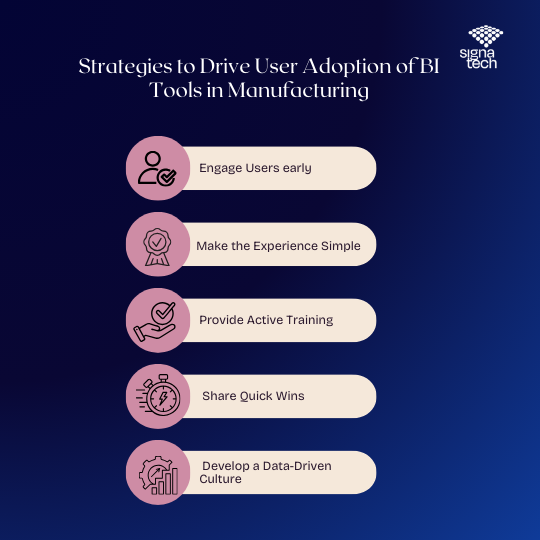
Strategies to Drive User Adoption of BI Tools in Manufacturing
- Engage Users early
Don’t develop BI dashboards in a bubble. Bring in the production managers, operators on the line, and supply chain personnel during the configuration of the dashboard. When users see that the tool is built to satisfy their requirements and needs, their use of it will significantly increase.
- Make the Experience Simple
- Begin with the user experience which begins with your dashboards. Create easy-to-understand dashboards for each role, or functions as you might call them.
- Don’t bombard them with dozens of charts.
- Create drill down options for those who become advanced users of the tool, and keep a simple top-level view for everyone else.
- Provide Active Training
- Training support can’t just be a one-day event. You must put in place:
- Workshops based on roles: Quality management learns about defect analysis, logistics learns about tracking supply and so on.
- On-the-job support: A peer champion or “BI ambassador” who can answer questions on the floor.
- Self-learning resources: Short videos or resources they can easily access at any time to learn.
- Share Quick Wins
- Demonstrate how the tool can resolve day-to-day pain points.
- Reduce machine down time by predicting when you can work on your maintenance schedule.
- Reduce waste by tracking the use of raw material.
- Improve on-time delivery by tracking visibility in the supply chain.
- Quick wins, and little wins build confidence back to employee engagement with BI.
- Develop a Data-Driven Culture
- User adoption of a BI tool is not merely about the software but changes cultural attitudes of staff.
- Exemplify and celebrate those who embrace BI when he/she improves current organizational performance.
- Make BI dashboards part of team meetings.Promote leadership to utilize BI when making decisions through referenced dashboards.
- Ensure Data’s Accuracy and Trust
- When data cannot be relied upon, adoption will stop.
- Automate data gathering when able.
- Put limits on potential data inconsistency with the establishment of validation rules.
- Delegate data stewards to those accomplishing quality quality control acting across departments.
- Adopt BI to Existing Work Ways
- Do not expect employees to log into a separate BI portal:
- Place dashboards into an ERPs or manufacturing execution systems.
- Allow for mobile access to see KPIs immediately on-site.
- Monitor insights and share alerts and notifications that have actionable insights.
- Adopt and Measure
- Monitor adoption metrics: number of active users per week; frequency of accessing dashboards; and what reports are most frequently accessed.
- Take regular feedback and inform further changes to the system as needs begin to inform evolution.
Practical Bullet-Point Checklist
If you want to increase user adoption of BI tools in manufacturing, organizations need to:
- Include users from the planning session to implementation.
- Design simple dashboards that are role based.
- Facilitate ongoing, informal desk-side-on -the-job training.
- Promote quick wins to accelerate, build momentum, and discover further quick wins.
- Encourage a data-driven decision culture actioned by leadership.
- Ensure consistent accurate data is available to all staff to keep continuity.
- Embed BI seamlessly into workflow.
- Monitor ongoing usage and continue to refine.
The Payoff: Smarter Manufacturing Decisions
When adoption is approached, correct BI no longer is a data reporting tool and rather becomes a decision-making partner. Manufacturers will:
- Reduce downtime and waste.
- Better forecast demand and inventory.
- Plan production more efficiently.
Ship to customers quicker and more accurately increasing satisfaction.
The real piece and challenge of BI is not implementing it but figuring out the association of tools to workflows for manufacturing teams. Success begins with creating a culture of trust in the data, and ensuring every employee sees the value on a minimum daily basis in using BI. If we continue to keep experience, training, and culture-driven approach, organizations can benefit and realise the value of Business Intelligence.
Signatech works with manufacturing businesses to facilitate this type of adoption. In addition to having the right approach, we bring proven experience with Business Intelligence consulting services, BI tools, and the implementation and ongoing adoption process, which lead to the desired benefits of measurable ROI. If your goal is to help your teams access data, understand what data means, and make decisions based on data, Signatech can support you in making Business Intelligence a natural way of working in your manufacturing operations.