

Understanding the Power of Digital 360 Analytics
In a data-driven world, businesses are no longer making marketing decisions based purely on intuition. Every click, search, and interaction tells a story, and those stories, when analyzed correctly, lead to better results. That’s where Digital 360 Analytics comes in.
Digital 360 Analytics is a comprehensive approach to understanding customer behavior across every digital touchpoint from social media and websites to mobile apps and email campaigns. It provides marketers with a unified view of how customers engage, what influences their decisions, and which channels drive the best ROI.
By integrating data from multiple sources, businesses can finally move beyond surface-level metrics like impressions or likes. Instead, they can gain deep, actionable insights — such as why certain users drop off at checkout, which ad campaigns actually drive conversions, or how content performs across different demographics.
The Shift from Isolated Metrics to 360-Degree Insights
Traditional analytics often work in silos web analytics tell one story, social media analytics tell another, and ad reports tell a third. The result? Fragmented data that hides the full picture.
With digital 360 analytics, marketers combine all these data points into a single, centralized view. This unified approach helps in:
- Mapping the complete customer journey: From the first ad view to the final purchase, you can visualize every step.
- Identifying hidden patterns: Analytics can reveal when and where users are most likely to convert.
- Reducing marketing waste: By focusing on high-performing channels, businesses can eliminate unnecessary spending.
- Improving personalization: Understanding user behavior helps create targeted, meaningful experiences that drive loyalty.
This integration also allows predictive modeling helping brands forecast trends, anticipate customer needs, and respond proactively instead of reactively.
Turning Data Into Smarter Decisions
Collecting data is easy. Turning it into actionable insights is where the challenge lies. Digital 360 Analytics bridges that gap by converting raw data into meaningful intelligence.
For example, a retail brand can use 360 analytics to understand that users who browse at night are more likely to purchase discounted items, while morning users engage more with premium products. This insight allows the marketing team to segment audiences and adjust promotions based on behavior not guesswork.
Similarly, a B2B company can use 360 analytics to track which LinkedIn campaigns attract decision-makers and which email sequences convert them into leads. Instead of spending blindly, the company can focus on high-performing funnels that drive measurable results.
Key areas where digital 360 analytics enhances decision-making include:
- Campaign optimization (what works, what doesn’t)
- Conversion rate improvement
- Audience segmentation and targeting
- Predictive customer lifetime value
- ROI tracking and budget allocation
Integrating AI and Machine Learning into Digital 360 Analytics
The next evolution of digital analytics lies in AI-driven automation and predictive modeling. With AI integration, digital 360 analytics platforms can not only track user behavior but also predict future actions.
For instance:
- Predictive Analytics can estimate which customers are at risk of churn.
- Recommendation Engines can suggest the next best offer based on past purchases.
- Sentiment Analysis can evaluate customer emotions across social media comments.
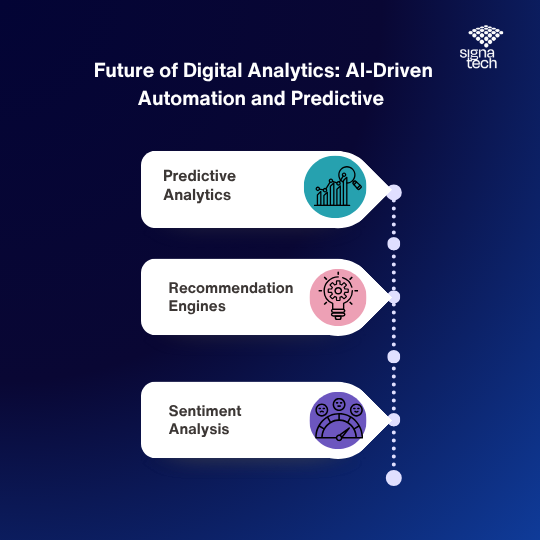
These intelligent layers transform analytics from descriptive (what happened) to prescriptive (what to do next). Businesses that adopt AI within their analytics systems gain a significant competitive edge — they can react in real time, personalize experiences automatically, and scale their insights effortlessly.
Building a Data-Driven Marketing Culture
Technology alone isn’t enough. For digital 360 analytics to deliver its full value, organizations must foster a data-driven culture. That means ensuring that every marketing decision — from creative design to ad spend is backed by insights.
To build such a culture, brands should:
- Break down data silos — unify analytics from sales, marketing, and customer service.
- Educate teams — ensure everyone understands how to interpret reports and dashboards.
- Define key metrics — focus on business outcomes like revenue growth or lead quality, not vanity metrics.
- Encourage experimentation — use A/B testing and campaign tracking to refine strategies continuously.
Once data becomes central to the marketing mindset, teams can pivot quickly, optimize campaigns instantly, and create consistent customer experiences across platforms.
Real-World Benefits of Digital 360 Analytics
Businesses that adopt digital 360 analytics experience significant improvements in their marketing performance. Some of the most measurable benefits include:
- Enhanced Customer Understanding: Gain visibility into preferences, purchase intent, and journey paths.
- Increased Marketing ROI: Identify high-performing channels and eliminate wasteful campaigns.
- Better Customer Retention: Predict behavior, personalize outreach, and maintain engagement post-purchase.
- Faster Decision-Making: Dashboards and real-time analytics empower teams to act on data instantly.
- Holistic View of Performance: Combine website, app, CRM, and social data for unified insight.
Ultimately, this level of intelligence allows marketing teams to make informed decisions, not assumptions.
Implementing Digital 360 Analytics in Your Organization
The implementation of digital 360 analytics begins with data collection and integration. Identify all data sources website analytics, CRM systems, social media platforms, and advertising dashboards and ensure they flow into a single analytics hub.
Next, establish custom KPIs and dashboards tailored to your goals. For example, a hospital might track patient inquiry sources, while an e-commerce brand focuses on average order value and conversion rates.
Finally, maintain ongoing monitoring. Data is only powerful when it’s continuously analyzed and refined. Use monthly performance reviews and quarterly audits to adapt to new market trends.
In the modern marketing landscape, digital 360 analytics is no longer optional — it’s essential. By unifying customer data, automating insights with AI, and building a culture of data-driven decisions, businesses can market smarter, not harder.
Whether you’re optimizing campaigns, personalizing customer journeys, or forecasting future demand, a 360-degree analytics approach gives you the clarity and confidence to move ahead of the competition.
For advanced analytics solutions and real-time data intelligence, partner with SignaTech, the experts in Digital 360 strategy, reporting, and transformation.
Empower your marketing with SignaTech’s Digital 360 where insights turn into impact.