
As a result of consumer demands for individual-focused experiences, retailers are utilizing increasingly sophisticated tools to satisfy that consumer demand. Business Intelligence is the largest among those tools. Retail BI provides deep insights into customer behavior, trends, and preferences, which provides for retailers to offer personalized experiences that will create loyalty and revenue.
The Role of BI in Personalizing the Retail Experience
Retail Business Intelligence is a game changer for businesses looking to expand their customer experience. BI provides real-time data analysis that provides retailers a much better understanding of their customer and creates a more individualized customer journey. By pulling and analyzing data derived from online transactions, purchases in-person, customer review data, and social media activity, Retail BI is able to provide insight into what customers value, when they value it, and how they like to purchase. In direct relation to, retailers can provide personalized discounts/offers or personal recommendations based on that data by recognizing behavioral patterns and monitoring price sensitivity. For example, e-commerce stores may monitor a customer’s previous browsing history and provide product offers based on that behavior. Or, brick-and-mortar retailers can utilize BI to track customers and foot traffic and product purchases and avoid stockouts on trending items. This level of personalization provides a more comprehensive and enjoyable customer experience that results in retention and loyalty and elevates happiness in shopping.
The Benefits of Retail Business Intelligence
Increased customer segmentation. BI allows retailers to segment customersBy examining information about customer demographics, purchasing patterns, and preferences, retailers can develop targeted marketing strategies that directly relate to each segment. For example, a retailer may segment their customers’ data into age groups, locations, or purchasing history, and develop offers and promotions based on each group. This ensures that customers have access to information that is important and timely which increases the likelihood of a purchase.
Enhanced Management of Inventory: Another benefit that business intelligence provides to the retail industry is inventory optimization. Retailers analyze data to forecast demand for their merchandise and make sure they have enough of the right products available and on-hand at the right time. This does not only allow the retailer to mitigate the undesirable situations of over-ordering and under-ordering products, it allows them to streamline their entire supply chain and operate at a leaner, more efficient level. For customers, this allows for the items they are looking for to exist in stores, providing for a much more fluid and worthless shopping experience.
Personalized Marketing: Armed with insights from BI, retailers can develop personalized marketing messages and offers. In email, sms, or in app message, retailers can send personalized offers to their customers based on their purchasing habits, location, and preferences. For example, a customer who frequently purchases running shoes may receive an exclusive offer on a new line of fitness apparel. Whenever there is a sense of personalization, customers often feel appreciated and understood which translates to higher customer retention and customer life value.
Better Customer Service:Retailers can use BI to improve the consumer experience by leveraging data to discover pain points and areas of improvement. Analyzing customer feedback, service interactions, and transaction data allows retailers to better understand where their customers are facing issues, so they can be proactive in addressing that – be it applied to an improved return process, a faster checkout experience, or more convenient delivery options. The enhancement of customer service will build relationships with your customers and build brand loyalty.
Real-World Examples of BI in Retail Personalization
Several leading retailers are already using BI to create personalized experiences and enhance customer satisfaction. For example, Amazon utilizes BI to recommend products based on a customer’s prior purchases, searches, and even items in the cart. The core algorithm at the heart of the platform will pull information from millions of data points into a customer’s past in order to generate recommendations that are extremely relevant; thus driving even more sales and keeping customers engaged. Other examples of BI work happening at customer-centric retailers include Starbucks and Walmart. Starbucks utilizes the data its customers provide every time they use their Starbucks loyalty program. Their data analytics can offer personalized rewards and discounts based on a customer’s purchasing patterns, indicating a customer’s favorite drink(s), previous orders, and the number of times they have visited the store. With classified and curated customer information, Starbucks can find opportunities to promote targeted promotions to enhance the incentive for return visits. Similarly, Walmart looks at shopping trends through the use of BI to identify stock levels as well as personalized deals and promotions to send customers through the Walmart app,Implement Retail Business Intelligence in Your Business
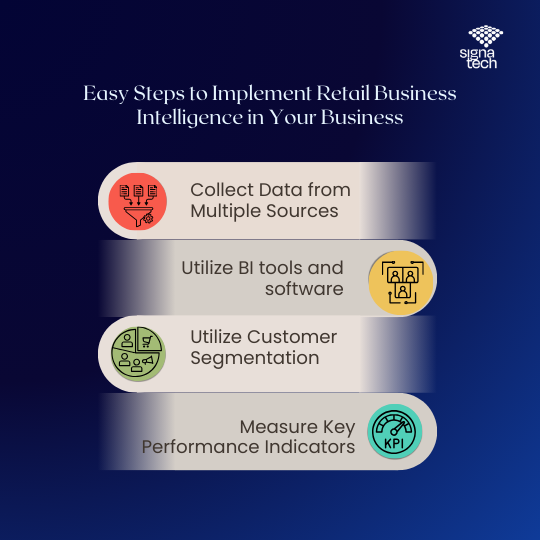
The implementation of Retail Business Intelligence (BI) into your business does not have to be a complex process. Here is a quick guide on how to get started.
Collect Data from Multiple Sources: The first step of the BI implementation process is collecting data from all possible data sources. Possible data sources can come from point-of-sale (POS) systems, customer relationship management (CRM) systems, website analytics, social media, and customer surveys. The more data you can obtain, the more you can analyze.
Utilize BI tools and software: There are a greater variety of BI tools that can assist you with the analysis and visualization of data. There are many BI tools including Microsoft Power BI, Tableau, and Qlik Sense that can help you visualize the data along with user-friendly dashboards and reporting dashboards.
Utilize Customer Segmentation: After you have obtained data, the next process is customer segmentation. Customer segmentation is the grouping process to analyze customers by purchasing behaviors, demographic factors, and other factors of preference which can assist with your personalized marketing campaigns and promotional offers.
Measure Key Performance Indicators (KPI): To measure the effectiveness of your BI, it is important to measure key performance indicators. Some useful KPI’s to measure for retail are customer lifetime value (CLV), conversion rate, average order value (AOV), and customer retention rate.
Take Advantage of AI and Machine Learning: BI tools are now extending capabilities with advanced algorithms for AI and machine learning to forecast predictive behavior, anticipate demand, and even automate certain marketing services. Utilizing these technologies provides further refinement on personalization and allows a more optimal personalized customer experience. Retail Business Intelligence is extremely powerful in enhancing the overall customer experience, creating personalized experience, and refining retail operations. From enhanced customer segmentation, enhanced inventory management, and enhanced personalized marketing – BI has numerous dynamics which can drive customer satisfaction, loyalty, and sales. If you want to remain competitive in the retail market, you do not have an option of not having BI.
At Signatech, we want our customers to leverage the transformational power of Business Intelligence within retail. Our advanced BI solutions are meant to assist retailers in the sophistication of BI capabilities, which can allow them to make informed decisions to optimize the retail operation, and provide outstanding customer experience. We welcome the opportunity to assist your retail enterprise improve your marketing services or inventory management services. Contact us to get started on how we can assist you in using BI to advance your retail enterprise.