
In a fast-paced business landscape, productivity is important to stay competitive. Teams need to work together effectively, access real-time data, and be able to make informed decisions quickly. The challenge becomes making this happen when systems don’t work together, and the information is fragmented across platforms. Finding ways to combine work-arounds, lack of information, and manual work takes time and can also prove costly in lost productivity.
This is when integrating with an existing Salesforce platform becomes essential!
Knowing that Salesforce is one of the most powerful CRM platforms, it becomes even more powerful when it is integrated with the tools your team is already using. By connecting everything from email and marketing automation, customer support, and analytics platforms with Salesforce integration – it can create a connected environment to make everything a well-oiled machine. You allow each of these critical pieces of the department to generate outputs and employ Salesforce to verify each step along the way.
Let’s take a look at the ways Salesforce integration improves team productivity across teams, and why it is important for growing companies.
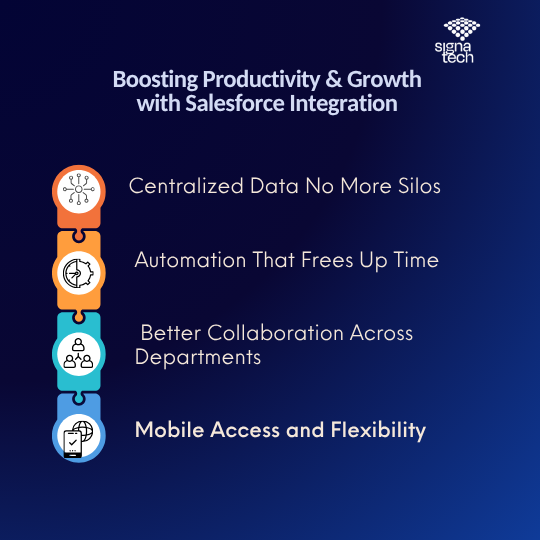
1. Centralized Data No More Silos
One of the most significant issues regarding lost productivity is data silos. Sales has its numbers, marketing has its campaign data, and customer support has tickets in the other system. Each department works in its own bubble, lacks communication, and doubles up on effort.
With Salesforce integration:
- All teams can access a single source of truth.
- No more switching between platforms or waiting for someone to export data.
- Real-time updates ensure everyone stays on the same page.
Whether it is syncing leads from the landing page, seeing customer history from the helpdesk, or watching all the sales pipeline data teams spend more time activating against data instead of hunting for the data.
2. Automation That Frees Up Time
Manual data entry, follow-ups, lead assignments, and reporting are all time-consuming tasks that hinder productivity.
Integrating Salesforce with tools like:
- Marketing automation platforms (e.g., Mailchimp, HubSpot)
- Customer support systems (e.g., Zendesk, Freshdesk)
- Calendar and email apps (e.g., Gmail, Outlook)
… allows your team to automate repetitive tasks.
For example:
- New leads can be auto-assigned to the right sales rep.
- Follow-up reminders can be triggered based on client behavior.
- Support tickets can sync with customer profiles for contextual responses.
By reducing manual tasks, your team can focus on strategic work—selling, serving, and scaling.
3. Better Collaboration Across Departments
Salesforce integration drives departments together. When tool integrations are used data becomes fluid, sales knows what marketing is doing, and support knows what deals have closed.
This improves:
- Lead handover quality from marketing to sales
- Customer onboarding speed by syncing sales and support data
- Campaign alignment with real-time sales feedback
Everyone works toward the same goal, using the same data, in real time.
4. Mobile Access and Flexibility
Sales teams and field workers frequently need to get customer data and act on the go. With Salesforce’s mobile app, and connections with GPS navigation, route planning and WhatsApp or SMS tools means remote productivity skyrockets.
Teams can:
- Update lead status on the go
- Access client information before meetings
- Get real-time task alerts and notifications
This level of flexibility ensures work continues from anywhere, without waiting to get back to the office.
5. Enhanced Customer Experience
When it comes to productivity, it is not only about internal speed, it is about how fast and well you serve your customers.
Integrated systems mean:
- Support agents know a customer’s full history
- Sales reps follow up with contextual messages
- Marketing sends personalized emails based on customer stage
This results in:
- Faster response times
- Higher satisfaction
- Better retention and upsell opportunities
A productive team is one that doesn’t just work fast, but works smart and in sync with customer needs.
6. Smarter Decision-Making With Unified Reporting
Without integrations pulling reports is an agonizing process; you need to export, clean, consolidate, and analyze data. This will slow down decision-making.
But with Salesforce integration:
- Dashboards pull in real-time data from multiple platforms
- Custom reports combine sales, marketing, and support metrics
- Leaders can spot bottlenecks, performance gaps, and growth opportunities instantly
7. Scalability for Growth
As your business grows, so does the complexity of your operations. Keeping track of tools and syncing data manually will become inefficient. By integrating Salesforce, you’ll know that your systems can keep up with you.
Adding new tools? Expanding into new markets? Further, onboarding team members?
With a strong integration foundation:
- Your workflows adapt easily
- Teams stay productive without process breakdowns
- New hires get onboarded faster through streamlined systems
Why Salesforce Integration Matters for Productivity
To summarize, here’s how Salesforce integration can directly improve your team’s productivity:
- Eliminate data silos with centralized access
- Automate repetitive tasks and save time
- Boost cross-team collaboration and communication
- Enable mobile flexibility for remote productivity
- Improve customer experience through data sync
- Empower leadership with smarter, faster reports
- Scale your team without losing efficiency
Ready to Supercharge Your Team?
At SignaTech we will help organizations gain the full benefits of Salesforce integration. We take pride in providing a full spectrum of custom Salesforce consulting services to ensure your unique needs are met. Our services include tool assessments, workflow mapping, API configuration, and real time data syncing.