
In progressive manufacturing, data makes up the most critical part of day-to-day operations. Manufacturers depend on many different sources of data: from production dashboards displaying live performance, production extract logs for quality checks, tracking past purchasing through customer ordering histories, to supplier contracts. Not only does losing such critical data bring about major inconveniences; it can halt production, lead to non-compliance issues, and possibly risk affecting long-lasting relationships with customers.
A mid-sized manufacturing company located in Milwaukee, Wisconsin, was unaware of a ticking time bomb hidden within its server environment, waiting to be exposed. However, through proactive predictive monitoring, the company continued operating smoothly without ever realizing that a major failure had been prevented behind the scenes.
This example clearly highlights the importance of Server Management Services in Wisconsin. By leveraging proactive monitoring, real-time alerts, and preventive maintenance, businesses can safeguard critical data, avoid unexpected downtime, and ensure uninterrupted operations protecting both productivity and customer trust.
“We were 72 hours away from losing five years of production data. We didn’t even know we were at risk.” Plant Manager, Milwaukee Manufacturing Unit
The Background: A Growing Manufacturer With a Silent Threat
The company in question is a 175-employee precision components manufacturer serving the automotive and heavy equipment sectors in Wisconsin. Like many manufacturers in the state, they had invested heavily in production equipment and shop floor technology but their back-end server infrastructure had been largely neglected for years.
Their IT environment included a primary on-premise file server, an ERP system hosting decade-long production records, a quality management database, and several departmental servers running critical business applications. All of it was managed reactively meaning IT staff responded only when something broke.
No one was watching what was happening beneath the surface. And beneath the surface, things were deteriorating fast.
The Warning Signs Nobody Noticed
A lot of problems were happening below the surface of their environment; unfortunately, no one could see any of those problems developing. At the time leading up to the near-catastrophic outcome, there were many warning signs of server failure; however, no one on the company’s two-man IT staff was able to identify any of those warning signs because they did not have any real-time monitoring tools available to them.
What was silently happening inside the servers:
- For more than three months prior to their scheduled maintenance window, the array of disks comprising the RAID system in use had suffered through two silent failures, leaving only one operational disk that would not provide any redundancy in the failure of its only functional counterpart.
- During the peak hours of production/operation, the CPU temperatures on the ERP server reached levels that caused them to throttle the CPUs to such a degree that their performance was degraded.
- The backup of the ERP system had been failing for 47 consecutive days, resulting in the creation of incomplete backup files that appeared successful from the standpoint of the operating systems and databases in use.
- The storage utilization for the Quality Management Database had crossed the 94% capacity threshold without any warning, creating a situation in which a forced shutdown of the system would be imminent.
- The Event Logs contained over 3,000 critical and warning-level alerts that had not been reviewed and had accumulated for more than six months.
With the exception of the failure of a RAID disk, each of these issues could have been addressed in isolation, however together, they represented a volatile situation with the ERP system being in a precarious state silenced by its impending catastrophic failure that would not provide any options for recovery.
The Turning Point: Bringing in Server Management Services in Wisconsin
After a recommendation from a neighboring manufacturer in Fox Valley, the company contracted a local server management service located in Wisconsin. During their first meeting the leadership team thought it was just a routine infrastructure review, not realizing at that time that they were in crisis mode.
The result of this meeting has been one of the most important IT engagements in the company’s history.
Week 1 – Emergency Infrastructure Assessment
Within days after being placed under contract with the Managed Service Provider, they deployed remote monitoring agents to all of the company’s servers and began to collect real-time telemetry data. The information collected during the first 48 hours was very worrisome and resulted in significant escalation.
The degraded RAID array was flagged as a Priority 1 critical risk, the backup validation audit revealed that the last fully restorable backup was 47 days old, and the company would experience a forced shutdown within 96 hours due to the crisis in storage capacity on the quality database.
The Plant Manager later said that the initial email notification of the first risk report was “the most unsettling email I have opened since working here.”
“They showed us a timeline. If we had gone another week without knowing, we would have lost everything on that server with no backup to restore from.” IT Coordinator, Milwaukee Manufacturing Unit
How Predictive Server Monitoring Worked in Practice
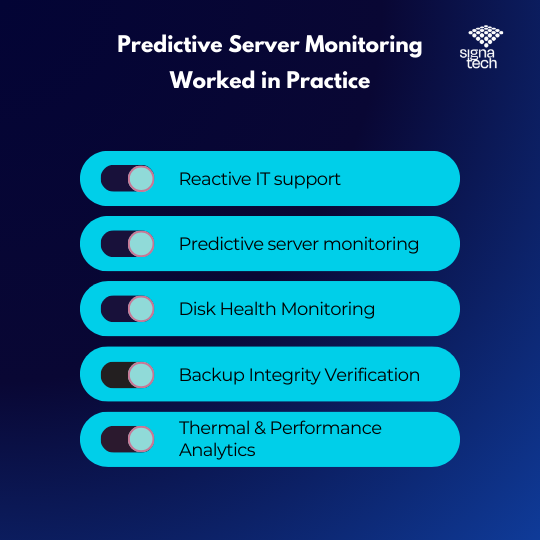
This case illustrates exactly why predictive monitoring a cornerstone of professional server management services in Wisconsin is fundamentally different from traditional break-fix IT support.
Reactive IT support waits for a failure to occur, then responds. By the time the response happens, data may already be lost, production may already be halted, and recovery costs are at their highest.
Predictive server monitoring continuously analyzes hundreds of health indicators across every server and uses pattern recognition and threshold-based alerting to identify failure trajectories before they result in an outage or data loss event.
In this Wisconsin manufacturer’s case, the monitoring platform tracked and flagged the following in real time:
Disk Health Monitoring S.M.A.R.T. diagnostics on every drive identified reallocated sectors, pending sectors, and uncorrectable error counts that indicated imminent drive failure. The degraded RAID array was caught at this stage before the final surviving drive failed.
Backup Integrity Verification Rather than simply confirming that a backup job “ran,” the monitoring system validated that backup files were complete, readable, and restorable. This is what exposed the 47-day backup failure that a simple job status log had hidden.
Thermal & Performance Analytics Continuous temperature logging and CPU utilization trend analysis identified the ERP server’s thermal throttling pattern, which was traced to a failing cooling fan, a $40 part that, if left unaddressed, could have caused a motherboard failure.
Storage Capacity Forecasting Instead of alerting only when storage hit 100%, the system used historical growth rate data to project when thresholds would be crossed giving the team a 3-week runway to plan a storage expansion rather than scrambling in crisis mode.
Event Log Intelligence The platform automatically triaged and prioritized thousands of system event log entries, surfacing the critical alerts that the internal IT team had no capacity to review manually.
The Intervention: What Happened Next
Armed with a complete picture of the infrastructure’s risk profile, the Wisconsin managed service provider executed a structured emergency remediation plan all while keeping production systems online.
RAID Array Recovery A hot spare drive was sourced locally and installed within 18 hours of the initial alert. The array was rebuilt with zero data loss. Had the final surviving drive failed before intervention a real possibility given its S.M.A.R.T. error count recovery would have required forensic data reconstruction at an estimated cost of $40,000–$80,000, with no guarantee of full recovery.
Backup System Overhaul The broken backup jobs were corrected, and a new tiered backup architecture was implemented: hourly incrementals to a local NAS device, daily encrypted transfers to an off-site Wisconsin data center, and weekly cloud vault replication. Backup integrity validation was automated going forward.
Storage Expansion & Data Archiving The quality management database server received an emergency storage expansion. A data archiving policy was implemented to offload historical records to lower-cost long-term storage, reducing active storage utilization from 94% to 61% within two weeks.
Thermal Remediation The failing cooling fan on the ERP server was replaced, and a quarterly preventive hardware maintenance schedule was established for all physical servers.
Event Log Management Automated alerting rules were configured so that critical and warning-level events triggered immediate notifications ensuring no high-priority alert would ever sit unreviewed for days, let alone months.
Why Wisconsin Manufacturers Need Local Server Management Services
The geographic dimension of this story matters. When the RAID array failure was identified, the managed service provider dispatched a certified engineer to the Milwaukee facility within two hours. The drive was sourced from a local supplier and the installation was completed the same day.
A national managed service provider operating from a remote NOC in another state would have faced significant logistical delays in replicating that response. For a manufacturer running three shifts, every hour of delay carries a direct cost.
The advantages of local server management services in Wisconsin include:
- Rapid on-site response times measured in hours, not days
- Deep familiarity with Wisconsin’s manufacturing industry landscape, compliance requirements, and supply chain dynamics
- Local data center partnerships for off-site backup storage within state boundaries are important for data sovereignty and compliance
- Relationship-driven service with dedicated account managers who understand your specific operational environment
- Time zone alignment for responsive support during all three production shifts
For manufacturers evaluating their options, the combination of local presence and enterprise-grade monitoring capability is what separates genuinely effective server management services in Wisconsin from generic national IT contracts.
Key Lessons for Wisconsin Manufacturing Leaders
This Milwaukee manufacturer’s near-miss carries important lessons for any production operation in the state running on server infrastructure.
- Silence Is Not Safety
The absence of visible IT problems does not mean your servers are healthy. In this case, a system was hours away from catastrophic failure while appearing to function normally on the surface. Only continuous monitoring reveals what’s actually happening inside your infrastructure.
- Backup Completion Is Not Backup Verification
One of the most dangerous assumptions in IT is that a backup job that “runs” successfully is a backup job that produces a restorable file. In this case, 47 days of backup jobs had run and produced corrupted, unrestorable output. Validation is not optional; it is the entire point.
- Reactive IT Is a Business Risk, Not Just a Technical One
When IT operates in purely reactive mode, the business assumes the financial risk of every undetected failure. Proactive server management services in Wisconsin transfer that risk management function to specialists with contractual SLAs that hold the provider accountable.
- Local Expertise Accelerates Recovery
When minutes and hours matter, the physical proximity of your IT partner determines how quickly a crisis becomes a footnote rather than a headline. Wisconsin manufacturers benefit significantly from partnering with providers who are geographically embedded in the state.
- Small Warning Signs Compound Into Major Failures
Each of the issues in this case the degraded RAID, the backup failures, the thermal spikes was individually manageable when caught early. Together, undetected, they formed a compound failure scenario. Predictive monitoring exists precisely to catch each issue at the manageable stage, before convergence.
The Milwaukee manufacturer in this case study got lucky but they also got smart. By engaging professional server management services in Wisconsin at what turned out to be the eleventh hour, they avoided a data loss event that could have cost tens of thousands of dollars in recovery fees, weeks of operational disruption, and potentially the loss of irreplaceable production records spanning half a decade.
Predictive server monitoring is not a luxury reserved for enterprise organizations. It is a business-critical capability for any Wisconsin manufacturer that depends on its data to keep production moving, customers satisfied, and operations compliant.
The question is not whether your servers will face failure conditions. They will. The question is whether you’ll know about it before the damage is done or after.
Ready to protect your Wisconsin manufacturing operation from data loss before it happens? Contact Signatech today for a complimentary server health assessment. Our Wisconsin-based team specializes in predictive server monitoring and proactive server management services in Wisconsin so your production never stops because your servers did.