
In hyper-competitive markets, businesses cannot afford inefficiencies in demand planning or inventory control. Stockouts lead to lost sales and customer dissatisfaction, while overstocking ties up cash flow and can result in waste. Traditional approaches such as spreadsheets, rule-based systems, and basic machine learning methods are often reactive and slow to adapt to the fast-changing dynamics of real-world scenarios.
This is where AI Agents for Demand Forecasting are fundamentally redefining demand forecasting. When grown organs and cities were often used in the past like static tools, AI Agents will act independently, access information in real-time, and learn expected behavioural outcomes in order to produce forecasts with a high level of accuracy. They will not only report forecasted demand but will also prescribe how to optimize inventory prior to any demand.
Why AI Agents Outperform Traditional Forecasting Methods
Unlike traditional methods that forecast averages or seasonal based patterns, AI agents can analyze very large amounts of structured and unstructured data like sales history, promotions, lead times from suppliers, consumer behaviour as related to demand intent, and signals from the external environment for example weather or economic indicators, in a very granular way.
Some of the key benefits include:
-
- Real-time Adaptation – AI agents are constantly reviewing their inputs and are able to implement real-time updates into their models.
- Autonomous Decision-making – AI Agents do not just forecast, they are also capable of acting independently to generate alerts for inventory, manual or automated re-ordering, or even setting dynamic pricing.
- Multi-Factor Analysis – AI agents are fundamentally different from traditional demand planning methods as they will never rely on just ‘sales history’. They are capable of analysing many horizons at once such as supplier reliability, competitor pricing strategies, or shifts in demand based by geography.
- Cost Management – AI Agents will ensure companies are operating or managing inventory to match actual demand thereby reducing holding costs, waste, or periods of emergency procurement.How AI Agents Improve Demand Forecasting
- Data Interconnectivity- AI agents interconnect with ERP, CRM, POS system and even third party API. Thus, gives an enhanced perspective of sales trends, promotions and external influences.
- Real-time Adaptation – AI agents are constantly reviewing their inputs and are able to implement real-time updates into their models.
How AI Agents Enhance Demand Forecasting
-
- Data Integration
AI agents integrate with ERP, CRM, POS systems, and even third-party APIs. This provides a 360° view of sales trends, promotions, and external influences.
- Pattern Recognition
Machine learning models inside these agents detect hidden demand patterns that humans or simple models may miss—for example, how weather affects beverage sales or how local festivals impact apparel demand.
- Scenario Simulation
AI agents can run multiple “what-if” scenarios: What if a supplier delays delivery? What if a competitor launches a discount campaign? Businesses can test resilience before risks occur.
- Continuous Learning
The more the agent is used, the smarter it gets. Unlike static models, these agents refine their accuracy over time without manual intervention. - Pattern Detection
Machine learning models integrated inside these agents, find those hidden demand patterns that are normally invisible to humans or simple models; for example, how the weather affects beverage sales and the demand in apparel when a local festival occurs. - Scenario Simulation
AI agents can perform numerous “what-if” scenarios such as, what if a supplier is late delivering? What if a competitor is discounting their similar product? A business can have their own simulations and know their resilience rating before encountering the risk. - Continuous Learning
The more use the agent gets the more intelligent it becomes. Unlike static modes these agents learn from their history obviously without any human interaction learning to drive their accuracy.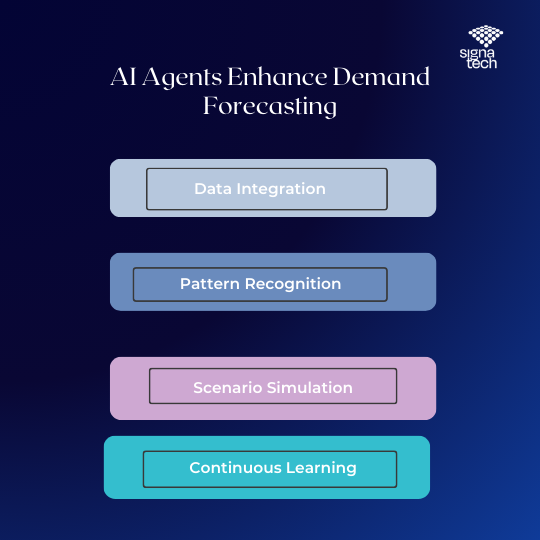
- Data Integration
AI Agents in Inventory Management
Demand forecasting and inventory management can’t be separated. AI agents will not only tell you what demand will be, but will also help you to act on it.
- Dynamic replenishment – AI agents have the potential to auto-generate purchase orders when stock levels are below predictive models.
- Safety Stock Level Optimization – Rather than just having a buffer safety stock, the safety stock can adjust automatically to lead time, demand variability and service level objectives.
- Multi-location Synchronization – For businesses that have multiple warehouses and/or locations, agents allocate stock inventory among regions to minimize logistics costs.
- Waste Reduction – Artificial Intelligence agents can reduce waste from expiry by deploying a demand forecasting function that learns sell-through and aligns orders accordingly. This is evident by implementation across perishable food and pharmaceuticals as well as discerning consumer seasonal demand in fashion.
Real-World Benefits
Organizations that are using AI agents for demand forecasting and inventory management find:
- 10-20% improve accuracies in forecasts
- 15-30% reductions in stock-outs
- 20-25% reduction in unnecessary costs due to excess inventory
Greater customer satisfaction and sales from improved product availability.
Bullet Points: Why Businesses Should Adopt AI Agents
- Increased speed and accuracy of demand forecasting.
- Real-time tracking and adaptation of demand forecasts.
- Automation to re-order items without human oversight reducing mistakes.
- Less working capital required to have tied-up in inventory.
- Comparison of supply chain enabled by greater resilience to or in disruptions.
- Improving customer satisfaction by minimising stock outs.
Implementation Considerations
While the benefits are compelling, successful adoption requires a structured approach:
- Data Readiness –Availability of appropriate data (with cleansed sales, supply chain and external signals).
- Integration –AI agents must able to link to ERP, WMS and POS etc.
- Pilot Projects –Start with a small product category and limited geographic range of coverage before expansion.
- Change Management –Training staff to trust the AI driven information and to collaborate with this type of insight vs only their gut feeling.
- Security and Compliance – Taking care of sensitive business and consumer data with proper governance.
Future Outlook
The next generation of AI agents will be even more proactive in solidifying automated action, and the use of generative AI (with autonomous workflows) will enable businesses to witness their AI agents negotiating with large suppliers, tailoring promotions to small retailers, and even coordinating logistics.
This shift will mark the transition from decision-support systems to decision-making agents. The fusion of AI Agents for Demand Forecasting and intelligent inventory management is reshaping supply chains worldwide. Businesses that embrace these technologies stand to gain agility, cost efficiency, and a competitive edge.
For organizations seeking to modernize their demand planning and inventory systems, leveraging an AI agent is no longer optional—it’s essential. At Signatech, we help businesses harness AI-powered demand forecasting and inventory intelligence to build smarter, future-ready supply chains.